















How automated labeling changes your label needs
Key takeaways:
- Automated labeling requires more precision than manually application.
- Labels have to be exactly to spec to work reliably in automated labeling systems without causing downtime, loss, and rework.
- Release and liner behavior, adhesive timing, and label construction all become important factors in automated labeling systems.
- Automated labeling processes and their labels should be designed together.
- Common mistakes like testing with temporary labels, designing labels after the automated process is finalized, or selecting label materials before thinking about your system are all easy to avoid.
- There are five easy steps you can take to successfully design and implement automated labeling.
- The stakes are higher when automated labeling happens in a regulated environment.
- You should seek expert help when designing or implementing an automated labeling process and/or if you’re experiencing intermittent problems with your labels.
Automated labeling requires precision
Humans are amazingly adaptable at tasks, including putting labels onto surfaces. Our dexterity, our responsiveness to small changes in label size or stickiness or thickness means that we can get most labels to stick to the thing they’re supposed to stick to.
Not so with automated labeling.
Why labels that have worked fail in automated labeling processes
Automated labeling machines are not adaptable. They are designed to repeat a certain action within a certain set of specs reliably and quickly many, many times every day. That means the labels you feed into them have to be exactly the same and exactly aligned to the requirements of your particular machine. And it explains why standard labels that performed fine when applied by hand suddenly fail when fed into an automatic labeling machine.
| Manual processes | Automated labeling processes |
| Operator adjusts pressure or placement | Release behavior must be consistent |
| Operator re-applies curled or misaligned labels | Stiffness and curl must be predictable |
| Operator can slow down when something feels off | Adhesion timing must be repeatable |
| Dimensionals tolerances are tight |
What suddenly matters in automated labeling
Look at it this way: if you’re applying labels by hand, they’re a consumable. But once you switch to automated labeling, your labels become a mechanical component of the system. That means your labels have to be just as precise and reliable as the other parts of the system if it’s all going to run smoothly.
Release and liner behavior
Unlike the human hand that can pull harder or softer to peel a label off its liner, automated labeling has tight release force tolerances that make liner construction matter far more than it does in manual application settings. Peel angle, speed, liner stiffness, and release consistency all affect whether a label feeds smoothly or begins to chatter, snap, or mis-register.
Adhesive timing
In manual applications, the question is: will this label stick. In automatic labeling, the question becomes: will it stick at this speed, pressure, and dwell time. Initial tack, wet-out timing, temperature, humidity, and any prior sterilization or environmental exposure can change the answer to that question from yes to no in an instant.
Label construction
Small variances in label construction aren’t a stumbling block for manual application, but they are amplified in automated labeling situations. Facestock caliber impacts registration. Curl memory affects edge lift and placement. Die cut consistency affects pick-and-place accuracy.
Automated labeling processes need to be designed in tandem with labels
Achieving automated labeling success isn’t a chicken or egg situation. It’s a chicken AND egg situation. Here at CleanMark, we’ve been helping companies switch to automated labeling (and rework failed attempts at moving to automated labeling) for a lot of years.
The biggest lesson we’ve learned? Successful automated labeling comes from designing and testing your labels and process together.
Since labels are an integral mechanical component of any automated labeling system, it makes sense that you’d run into problems if you design without them in mind. Applicators, placement methods, line speeds, and container geometry are all affected by and affect label construction and performance.
Also, most companies don’t have an automated labeling expert in-house when they first decide to automate. Bringing on a strong label partner, like CleanMark, early on means you have a partner to advise you on common missteps and short-cuts to success.
Common automated labeling mistakes
Speaking of those common missteps, here are a few we see often that lead to delays, rework and unexpected downtime. But, you can easily dodge them if you know what to avoid.
Selecting label material before your automated labeling process is fully designed
Our label design team carefully chooses every component of your label to conform to the requirements of your automated labeling process. If you don’t know what that process is yet, then you’re choosing label materials blindly, which never leads to a good result.
Validating your automated labeling system using surrogate or temporary labels
Remember when we said automated labeling requires precision? If you test using surrogate or temporary labels, you don’t know for sure that your permanent labels will meet the tight tolerances required by automated labeling systems. If it turns out they don’t, then you’re stuck reworking either the labels or your system.
Testing at bench conditions rather than production speeds
As line speed increases, your release window shrinks, which challenges your automated label system much more. Testing at production speed lets you know for sure if your labels can print, release, and adhere consistently as they’ll need to day in and day out during regular manufacturing.
Assuming material approval equals system readiness
There’s a reason we do lab testing, environmental testing, and then in-situ testing with our customers. It’s because the real world is always just a little different than artificially constructed testing environments. Finding the right material is a big step toward success, but you can’t know your system is truly ready until your label has successfully run through a production speed test in your facility.
The right way to automate labeling
We’ve called out the ways companies get automated labeling wrong, but what steps do you need to take to get it right? Follow these high-level steps, and you’ll reduce the risk of a new system and be on your way to efficiency-boosting, reliable automated labeling.
- Understand your goals — What do you need your automated labeling system to do? What does success look like? This can be very basic, but orienting yourself early on leads to quicker design and implementation.
- Involve a label expert early — Finding a label partner experienced with label construction and automated labeling process helps avoid mistakes (like those above) and lets you step away from the technical details to focus more on your larger business goals.
- Design your labels and automated labeling system together — When you take into account the strengths and inherent limitations of all of your process components, including labels, during the design phase, you’ll end up with an optimized solution and fewer surprises.
- Consider all label components — Just as your automated labeling is a system, so is each individual label. Make sure your label partner has an experienced material science team and access to the latest adhesives, facestocks, liners, and coatings to ensure you get the highest-functioning label possible.
- Test at production speeds and conditions — Once you’ve completed the design of your automated labeling system and labels, test them together at production speeds and conditions to ensure there are no surprises.
The stakes are higher in regulated and high-reliability environments
The reliability of an automated labeling system is key in any manufacturing operation, but especially so in regulated and high-reliability environments. In these scenarios, labeling failures aren’t just cosmetic, they can jeopardize your customers’ safety and put you at risk of noncompliance.
- Batch delays — faulty labels must be checked and/or reworked
- Validation complications — missing, misapplied, or illegible prevent validation
- Supply interruptions — incorrect or missing labels impede supply chain tracking
- Compliance risk — faulty or failed applications can go afoul of mandatory traceability and safety requirements
Is it time for you to talk to CleanMark?
We’re always happy to chat with you about labels, whether you’re ready to make an order or not. It’s our passion! But, there are some key times when we recommend reaching out so we can support your label needs.
If you’re doing or considering doing one of the following, schedule a consultation with us and we’ll walk you through the process.
- Transitioning from manual to semi-automated or automated labeling
- Designing or validating an automated labeling process
- Seeing intermittent issues in your automated labeling process
In the meantime, if you’re looking for some more info on how we design labels for automated labeling systems, visit our technical services page on label automation.
Looking for more detailed information?
Explore case studies, articles, guides and more in our extensive library of labeling resources.

The automation label: materials and construction matter

Why your automated label applicator and labels should be designed together
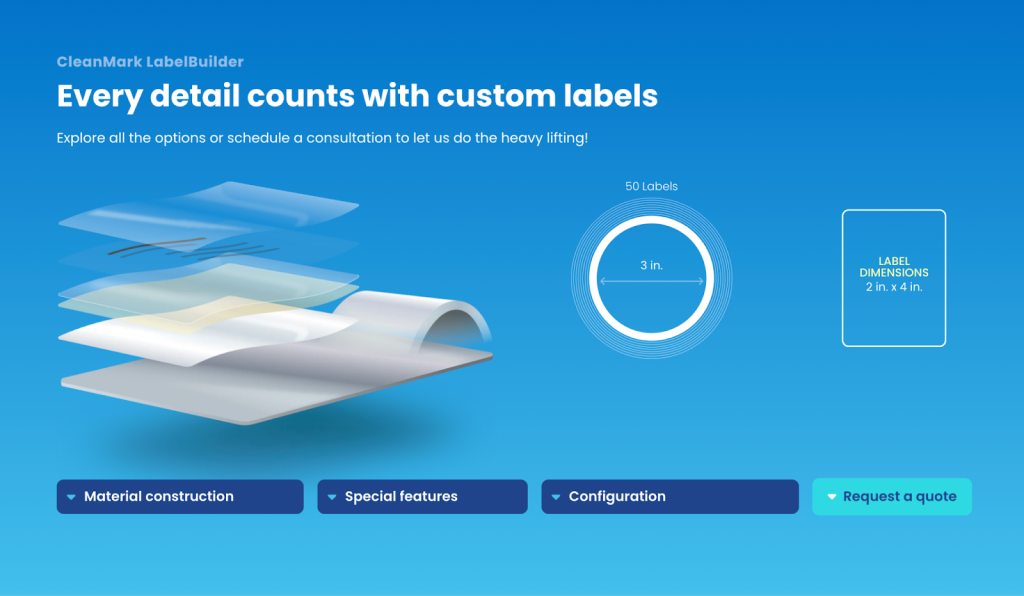
Harness the power of the CleanMark LabelBuilder
Stay up to date on labeling advances in your industry
From white papers to industry surveys and ebooks, we’ll make sure you’re informed about the latest technology that can make your operations more efficient and less stressful.

