













The automation label: materials and construction matter
Key takeaways:
- When an automation label fails, the root cause is often the label design, not the applicator machine that applied it.
- Applicator machines can confirm motion and contact, but they cannot verify bond quality, material behavior, or long-term performance of an automation label.
- Reliable automation labels must be engineered as part of the overall system, accounting for machine constraints, environmental conditions, and production timing.
- Small material and construction details in an automation label can have outsized impacts on line stability, uptime, and product quality.
- Many automation label problems only appear downstream, long after a label has been successfully applied and the machine has moved on.
Hidden factors in automation label design
Often, when something goes wrong with automating labeling, the applicator machine isn’t the problem. Label construction and materials are.
An automation label requires materials and construction that stay within tight tolerances while meeting the broader needs of the production process, like environmental durability, sterility or cleanroom compatibility.
At CleanMark, our technical services team looks at five hidden factors of labels that ensure our automation label solutions work reliably within your unique system.
- Adhesive performance
- Liner construction
- Line speed
- Film selection
- Roll construction
These same five aspects of your label construction and materials are a great place to start troubleshooting if your automation label isn’t performing as expected.
Automation label factor 1: adhesive performance
In an automated environment, your machine can confirm that a label was dispensed and is no longer present on the liner, but it cannot confirm whether the adhesive achieved a durable bond. That gap between “applied” and “successfully bonded” is where many automation failures originate.
| Applicator can confirm | Applicator CANNOT confirm |
| Label presence | Proper wet-out |
| Label release from the liner | Adhesive behavior both on and off the liner |
| Contact with the product | Long-term bond durability |
| Resistance to lifting in real-world production environment |
To close the gap, your label adhesive needs to be designed with the limitations of your applicator machine and other environmental stressors in mind.
Low-surface-energy (LSE) substrates
Many medical, industrial, and packaging applications involve low surface energy (LSE) materials. These surfaces resist wetting, which means adhesives do not naturally spread and anchor the way they do on higher-energy substrates.
In automation, this becomes especially critical for the following reasons:
- The contact window may be short.
- Pressure may be limited by the applicator design.
- There may be no secondary manual smoothing step.
If the adhesive is not designed for LSE conditions, the applicator machine may register a successful application, when in reality, you’ll experience symptoms of poor adhesion down the line:
- Edge lifting
- Incomplete wet-out
- Reduced ultimate bond strength
Required application pressure
Pressure-sensitive adhesives rely on pressure to flow into the microscopic texture of a surface. In automated situations, that pressure is controlled by:
- The applicator method (wipe, tamp, blow, or combination)
- Pad design and dwell time
- Line speed
If the pressure applied by the applicator machine is lower than what the adhesive requires, bonding can be compromised. And, unlike with manual-application labels, an automation label does not allow for intuitive adjustments in pressure or technique. The adhesive must be engineered to perform within the mechanical constraints of the applicator.
Required bonding time
Some adhesives exhibit strong initial tack but require time to reach ultimate bond strength. This can be a problem in label automation systems if labels don’t have sufficient time to set:
- The product may move immediately after labeling.
- Labels may be subjected to handling or packaging shortly after application.
- There may be limited dwell time before downstream processes begin.
If bonding time is not accounted for in the system design, an automation label can appear secure at application but fail later in the workflow.
Moisture and wet-out behavior
In many automated environments (particularly post-sterilization, cold storage, or shrink-wrapped processes) moisture may be present at the point of application. Residual steam, condensation, or surface dampness can interfere with adhesion.
In these conditions, adhesives have to rise to the challenge of the conditions:
- Wet out even in the presence of moisture
- Displace water on the surface
- Push moisture toward the edges of the label
- Be able to form after application
If these goals aren’t accomplished, moisture can prevent the adhesive from making good contact with the substrate. The end result is the applicator appears to be working successfully, yet the automation label fails to adhere longterm.
Automation label factor 2: Liner construction
Applicator machines are often calibrated based on label presence and placement, but liner performance also has a direct impact on labeling success. It directly affects tension stability, release consistency, and overall line uptime. Poor liner design can introduce failures that look mechanical at first glance but actually originate in material selection and construction.
Release coatings
For a liner to be reliable in an automated environment, its release surface must behave same consistently from the beginning of the roll to the end. Inconsistent release force can cause an automation label to peel too easily in some sections of the roll and stay stuck on the liner in others, leading to unpredictable results at the peel bar. These inconsistencies also directly affect liner tension upstream and label transfer downstream, causing even more problems. And, these problems compound at high line speeds.
Stiffness
As the liner moves through the applicator, it must navigate tight turns, rollers, dancer bars, and other tension-control components. The stiffness of the liner be designed with these physical pathways in mind.
A liner that is too flexible may stretch, wrinkle, or lose tension as it moves through the machine. A liner that is too stiff may have trouble bending around rollers, track incorrectly, or create tension spikes. In either case, inappropriate stiffness can destabilize label application causing both at-the-applicator issues and downstream quality problems.
Stretch
Stretch is a big factor in how well a liner maintains consistent tension. If a liner stretches drastically under load, label spacing and registration can shift as the liner moves through the machine. This can affect the timing of label presentation at the peel bar and disrupt sensor readings. Stretch-related issues cause the most issues in labeling systems that rely on precise timing between liner movement and product movement. In those set-ups, the machine assumes the liner will behave predictably under shear and tension. When it doesn’t, mistakes happen.
Die cuts
The precision of an automation label’s die-cut also directly affects how the liner and label separate under tension. If die cuts are too shallow, the label may not release cleanly from the liner, increasing resistance at the peel point and placing additional shear stress on the liner. If die cuts are too deep, adhesive can migrate into the cut edge, making labels harder to peel and increasing liner breakage. Or, the liner can tear, causing pad peel issues and inconsistent performance. Errors from these scenarios, like slippage, misfeeds, or line-down events, are often misattributed to applicator calibration when they’re really a label design issue.
Material strength
The strength of your liner material affects how well it withstands shear forces as it is pulled, redirected, and rewound inside the machine. Liners with low strength may tear, deform, or fail under load, particularly at high speeds or during rapid acceleration and deceleration. Differences between paper and synthetic liners also have an impact on how the liner responds to stressors, like shear and tension.
Automation label factor 3: Line speed
Line speed determines how long a label exists in an intermediate state during production. Labels often pause after printing, after peeling, and before application, for example. If a label manufacturer fails to consider these pauses during label construction, the result is often an unreliable labeling system.
Time between prints
How quickly a printed label moves from the print engine to the point of application depends on line speed. In many automated systems, labels are printed immediately before being peeled and transferred. When the time between printing and application is short, the printed image must be stable almost immediately, no small task.
This introduces two critical considerations:
Ink choice
Ink must set without smearing, transfering, or distorting as the label advances through the machine. At fast line speeds, there may be very little time for ink to dry, set, or bond to the label surface before the label moves on to the next process.
Label surface receptivity
The other key to print stability is the ink receptivity of the label facestock and top coatings. If the surface doesn’t allow rapid ink setting or proper ribbon transfer, print quality will suffer as line speed increases.
Time labels sit exposed on tamp pads
In many automated systems, labels are peeled from the liner and held on a tamp pad with the adhesive exposed when the system pauses (usually for the reasons mentioned above). During those pauses, label construction must remain stable:
- Adhesives must maintain function
- Labels must retain shape and edge integrity
- Release behavior must remain consistent
If automation label materials aren’t designed for these conditions, problems arise. Poor transfer, misalignment, or post-application adhesive failure are the most common.
Automation label factor 4: Film selection
Film selection plays a central role in how reliably labels move through the label applicator, transfer to the product, and adhere after application. When film properties are not designed in sync with the applicator and environment, issues emerge (even when adhesive, liner, and machine settings look fine).
Film stiffness vs. flexibility
The balance between stiffness and flexibility determines how an automation label performs as it is peeled from the liner and applied to the product.
Release from the liner
A film that’s too stiff won’t bend properly at the peel bar, making it harder for the label to separate cleanly from the liner. This can increase resistance at the peel point and affect liner tension. A film that is too flexible may collapse or fold as it releases, particularly at higher line speeds.
Conformance to the product
Most products aren’t flat. So, film must conform to whichever shape needs to be labeled. Flexible films are generally better suited for curved, irregular, or small-diameter surfaces. Stiffer films often struggle to adhere to these more challenging shapes, increasing the risk of edge lifting.
Interaction with tamp pads and wipe mechanisms
In tamp, wipe, and hybrid application methods, film must transfer reliably from the liner to a pad or directly to the product. Stiffer films struggle to seat evenly on tamp pads or don’t make full contact during application. More flexible films typically transfer better but note that they’ll still need enough rigidity to avoid wrinkling or distortion.
Compatibility with printing systems
Printing technology must also be taken into account when selecting film.
Direct thermal, thermal transfer, ink jet, or laser
Choosing the right film for the printing method (direct thermal, thermal transfer, inkjet, or laser) used on the line ensures that printed data stabilizes quickly and remains legible. Incompatible films often result in poor print quality, incomplete transfer, or illegibility.
Coatings and surface treatments
Films often rely on top coatings to accept ink or ribbon transfer. Time, durability, and appearance are all factors in which to choose. At higher line speeds, time becomes one of top priorities.
Automation label factor #5: Roll construction
Even if you get the first four factors right, poorly thought-out roll construction can cause everything to fail: from feeding issues and tension instability to setup delays. Labeling machines assume a predictable roll format, so issues in roll construction often show up as mechanical problems. But in reality, the problem often lies in how the labels were wound and prepared.
How roll format affects machine feeding
Roll format drives how the liner unwinds, how smoothly labels arrive at the peel bar, and how reliably the liner rewinds after the labels have peeled off. If the roll doesn’t unwind evenly, the feed rates can fluctuate, disrupting timing and placement, even when machine settings remain stable.
Tension consistency throughout the run
Consistent tension depends on uniform roll construction from the outer wraps to the core. Changes in winding, roll density, or label alignment can cause changes in tension as the roll diameter decreases. These shifts affect the labels’ interaction with rollers, dancer bars, and rewind systems, upping the risk of slippage, misfeeds, or registration errors.
Setup efficiency and changeovers
Roll construction also has a direct impact on how quickly and reliably an applicator machine can be set up or reloaded. Well designed rolls allow operators to thread liners smoothly through the machine without labels peeling accidentally and catching on internal components. On the other hand, poorly designed roll construction increases setup time and raises the likelihood of errors during roll changes, particularly on high-speed or high-throughput lines.
Core compatibility and leader length
Applicators are designed to accept specific core sizes and formats. If the roll core is not exactly aligned with the applicator, mis-matched mounting can cause uneven unwinding or vibration during operation. Leader length (the section of liner without labels) is also important. It plays a key role during setup, allowing operators to thread the liner without fear of labels sticking to internal surfaces.
Label spacing and consistent sizing
Uniform label spacing and consistent label dimensions across the entire roll are also essential for accurate sensor readings and timing. Inconsistencies in spacing or size often cause sensors to misread label position, disrupting the synchronization between liner movement and product flow. These issues often intensify at higher line speeds, where timing tolerances are narrow.
Quick reference to automation label design factors
The level of technical detail necessary to design a high-performance automation label is demanding. We’ve consolidated the high points into this handy reference chart.
| Automation label factor | What it directly affects | What the applicator cannot confirm | Common failure symptoms if label not designed correctly |
| 1. Adhesive performance | Bond strength, edge integrity, long-term adhesion | • Proper wet-out• Adequate adhesive flow• Bond durability over time | • Edge lifting• Labels that appear applied but fail later• Reduced ultimate bond strength |
| 2. Liner construction | Tension stability, release consistency, line uptime | • Release variability• Stretch under load• Shear and slippage behavior | • Slippage• Misfeeds• Liner breakage• Line-down events |
| 3. Line speed | Timing between print, peel, and application | • Ink/print stability timing• Adhesive behavior during dwell time | • Smearing or unreadable print• Poor transfer from tamp pads• Inconsistent placement |
| 4. Film selection | Release from liner, conformance to product, transfer reliability | • Film stiffness mismatch• Conformance failures• Print durability over lifecycle | • Wrinkling• Edge lift• Poor fit on curved or irregular surfaces |
| 5. Roll construction | Feeding consistency, tension control, setup efficiency | • Uneven unwinding• Core or leader incompatibility | • Jams• Premature peeling• Setup failures during roll changes |
Or, better yet, schedule a consultation with one of our label experts and let us design a custom label for your automated system that checks all of the design boxes.
Looking for more detailed information?
Explore case studies, articles, guides and more in our extensive library of labeling resources.

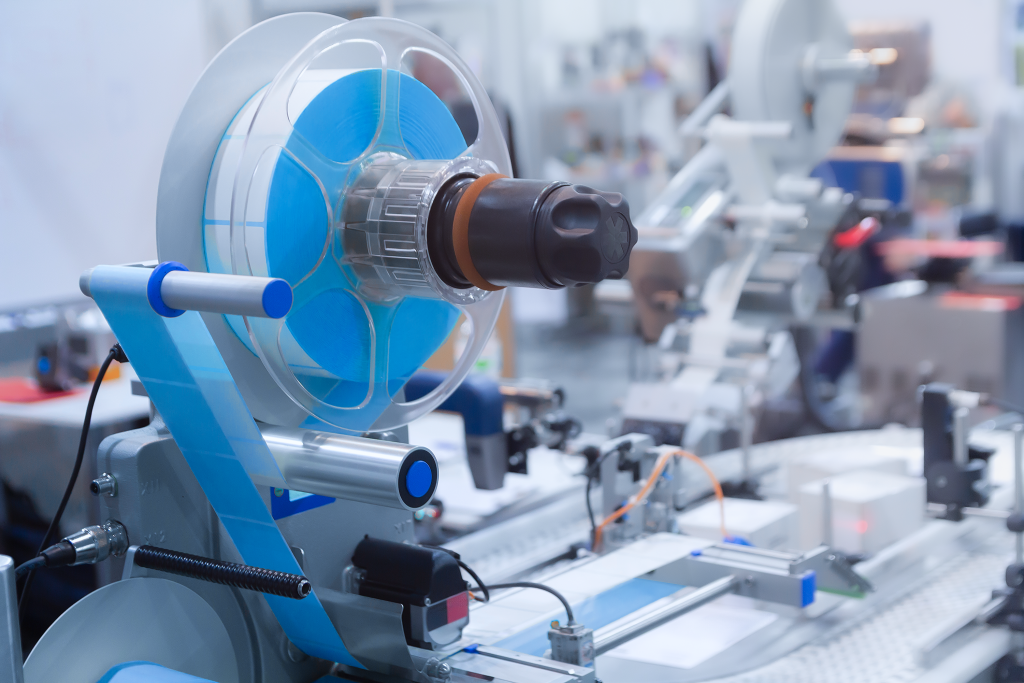
Why your automated label applicator and labels should be designed together
How automated labeling changes your label needs
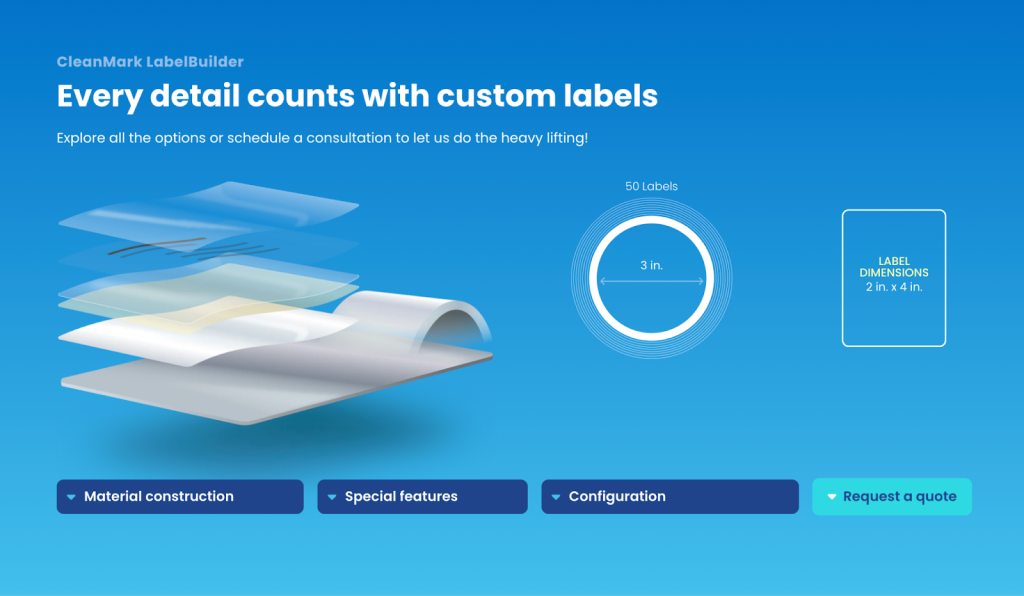
Harness the power of the CleanMark LabelBuilder
Stay up to date on labeling advances in your industry
From white papers to industry surveys and ebooks, we’ll make sure you’re informed about the latest technology that can make your operations more efficient and less stressful.

