
















Cold Chain Labels for Refrigerated & Frozen Applications
Cold chain labels are engineered to maintain reliable identification throughout refrigerated manufacturing, frozen storage, transportation, distribution, and end use. CleanMark engineers cold chain labels designed to perform despite temperature cycling, condensation, moisture, and other demanding cold chain applications.
Find the right labels
- Share your application
- Get expert guidance
- Move forward with confidence
Risks of using standard labels in cold chain applications
When standard labels are exposed to conditions they were not designed to withstand, the consequences often extend well beyond the label itself. Failed identification can disrupt product traceability, inventory accuracy, regulatory compliance, and overall supply chain performance.
- Identification loss
- Data capture failures
- Lost traceability
- Compliance risks
- Production disruptions
- Increased operating costs
What cold chain labels are engineered to do
Maintaining reliable identification throughout the cold chain requires more than selecting a label rated for low temperatures. Cold chain labels are engineered to remain attached, legible, and scannable despite refrigeration, freezing, condensation, handling, and transportation.
- Reliable adhesion
- Label integrity
- Print legibility
- Barcode readability
- Product identification
- Operation continuity
How to know when a cold chain label is needed
Specialized cold chain labels are needed when products must remain reliably identified throughout refrigerated manufacturing, frozen storage, transportation, distribution, and end use. Selecting the right label depends on the complete operating environment, how and when the label is applied, and the level of performance required throughout the product’s lifecycle.
| Cold Chain Labels | Standard Labels |
|---|---|
| Low temperatures are a critical part of the manufacturing process, storage, transportation, distribution, or product’s end-use environment. | Labels are used under normal ambient operating conditions where cold exposure is minimal or incidental. |
| Labels must maintain adhesion, print quality, and barcode performance despite condensation, frost, ice formation, humidity, repeated freeze-thaw cycles, and extended refrigerated, frozen, or cryogenic storage. | The application involves little or no moisture, temperature, cycling, or prolonged cold exposure. |
| Identification must remain securely attached legible, and scannable throughout manufacturing, storage, shipping, handling, and product use. | General-purpose identification is sufficient for standard operating environments. |
| Labels may need to be applied to cold, refrigerated, or frozen surfaces while achieving immediate, reliable adhesion. | Labels are typically applied to clean, dry, room-temperature surfaces under standard conditions. |
| Reliable traceability, barcode performance, inventory accuracy, regulatory compliance, or patient and product safety depend on consistent label performance. | Long-term identification and regulatory traceability are not critical to the application’s success. |
| Label material, adhesive, print technology, surface substrate, environmental exposure, and expected service life are engineered together as a complete labeling system. | General-purpose label materials and adhesive adequately meet the application’s performance requirements. |
How cold chain labeling supports critical industries
Cold chain labeling supports a wide range of industries where refrigerated, frozen, or cryogenic environments are essential to manufacturing, storage, transportation, or product use. While the operating environments differ, each industry depends on reliable identification to maintain product traceability, operational continuity, and regulatory compliance.
Pharmaceutical manufacturing
Pharmaceutical products often move through refrigerated manufacturing, cold storage, and temperature-controlled distribution before reaching healthcare providers. Cold chain labeling helps maintain product identification, supports lot traceability, assists with regulatory compliance, and protects patient safety throughout the pharmaceutical supply chain.
Biotechnology & Life Sciences
Biologics, laboratory samples, clinical trail materials, and research reagents may spend months or years in refrigerated, frozen, or cryogenic storage. Cold chain labeling helps preserve sample identify, supports scientific reproducibility, and protects valuable research throughout it’s lifecycle.
Medical device manufacturing
Many medical devices, diagnostic kits, and temperature-sensitive components require refrigerated storage or controlled transportation before use. Cold chain labeling supports UDI compliance, product traceability, inventory management, and patient safety throughout manufacturing and distribution.
Food & beverage manufacturing
Refrigerated and frozen food products move through complex processing, storage, transportation, and distribution networks before reaching consumers. Cold chain labeling helps support inventory accuracy, food safety, product traceability, and efficient supply chain operations from production through delivery.
Engineering the right cold chain labeling system
Every cold chain application presents a unique combination of temperatures, application conditions, operating environments, and performance requirements. Before recommending a cold chain label, CleanMark begins by understanding three fundamental questions that determine the appropriate solution.
- The temperature at which a label is applied can be just as important as the temperature at which it must perform. Labels applied before refrigeration, onto refrigerated products, or directly onto frozen or cryogenic surfaces each present different adhesive and application challenges.
- Cold temperatures rarely act alone. Condensation, frost, humidity, repeated freeze-thaw cycles, handling, transportation, cleaning procedures, chemicals, abrasion, and the surface being labeled all influence performance. Understanding the complete operating environment helps determine the appropriate labeling system.
- Every application has different performance requirements. Some labels only need to survive refrigerated storage and distribution, while others must remain permanently attached, legible, and scannable throughout manufacturing, long-term frozen or cryogenic storage, transportation, and the product’s entire service life.
How we engineer label performance for your application
Label performance depends on how materials interact with your environment, surfaces, application processes, and workflow requirements.
Chemical exposure
Resistant facestocks and coatings protect printed information from solvents, disinfectants, and harsh cleaning agents.
Cleaning cycles
Abrasion-resistant materials withstand repeated wipe-downs without degrading readability or adhesion.
Temperature conditions
Materials are selected to remain stable across cold storage, ambient, and high-heat environments
Removal requirements
Adhesives are selected based on whether labels need to remove cleanly or remain permanently bonded over time.
Surface type
Adhesives are matched to plastics, metals, glass, textured materials, and other challenging surfaces.
Application method
Label constructions are designed to support manual, semi-automated, and automated application processes.
Print method
Topcoats are selected to support durable, legible printing across thermal transfer, direct thermal, laser and inkjet systems.
Size considerations
Label dimensions are matched to available surface area, barcode requirements, and readability needs
Shape requirements
Label shapes are designed around containers, equipment, packaging, and workflow constraints.
Built around your workflow
Label performance is also influenced by how labels are dispensed, handled, packaged, stored, and integrated into day-to-day operations.
Labels per roll
Configured to support production throughput, operator handling, and storage requirements.
Perforations
Designed to improve dispensing, separation, handling, and workflow control.
Special liners
Release liners are selected to support clean handling, reliable release performance, and automated application requirements.
Core size & rewind direction
Roll configurations are matched to your printers and applicators for reliable feeding and operation.
Packaging requirements
Labels can be packaged to support cleanroom handling, sterile workflows, controlled storage, or protection during transport.
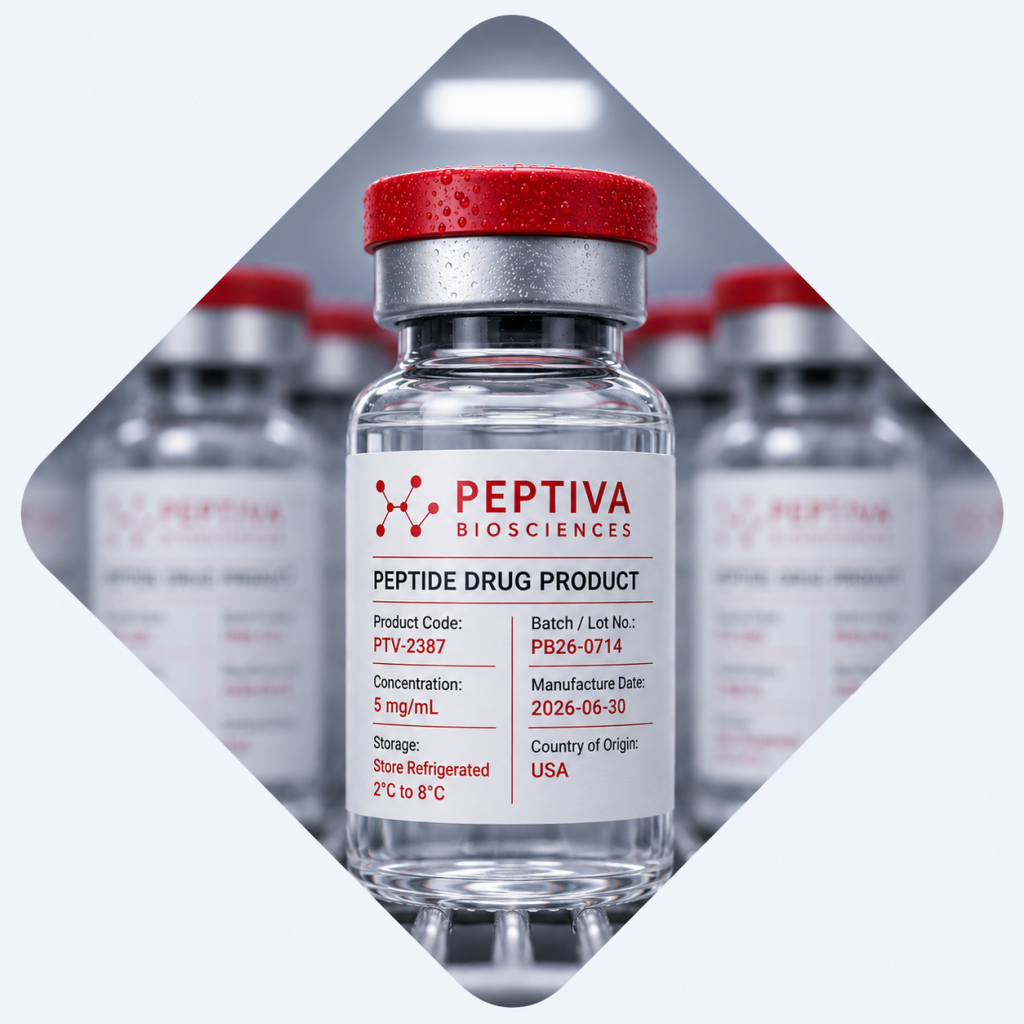
A cold chain labeling challenge for a peptide manufacturer
One example of a cold chain labeling challenge involved a peptide manufacturer seeking to improve product identification throughout its refrigerated manufacturing and distribution process. What initially appeared to be a straightforward request for a cold-resistant label quickly became a broader engineering challenge involving product traceability, regulatory compliance, and reliable identification across the entire cold chain.
Peptide products moved through refrigerated manufacturing, quality control, cold storage, packaging, distribution, and shipment before ultimately reaching healthcare providers. Throughout every stage, labels needed to remain securely adhered, legible, and scannable despite condensation, handling, temperature-controlled transportation, and extended refrigerated storage.
As we worked with engineering, quality, manufacturing, and operations teams, it became clear that storage temperature alone would not determine long-term performance. Together, we evaluated how and when the labels would be applied, the packaging materials being used, environmental exposure throughout the cold chain, barcode requirements, and the performance expectations at each stage of the product’s lifecycle.
Rather than selecting a label simply designed for refrigerated environments, CleanMark engineered the complete labeling system around the application. Material construction, adhesive performance, print technology, substrate compatibility, barcode durability, and operating conditions were evaluated together to develop a standardized solution that supported reliable product identification from manufacturing through final distribution.
That same engineering philosophy guides every cold chain labeling system we develop today. Long-term performance depends on more than low-temperature materials. It depends on understanding the complete cold chain process, aligning stakeholders around the application’s true requirements, and engineering a labeling system that performs reliably wherever the product is manufactured, stored, transported, and ultimately used.
Prefer to talk it through?
Our team can evaluate your environment, surfaces, application process, printing method, and workflow requirements to recommend a label construction aligned to your use case.

