














Autoclave Sterilization Indicator Labels for Regulated Manufacturing
CleanMark engineers custom autoclave sterilization indicator labels that combine a clear visual response to specified steam-process exposure with the product, container, or packaging information required for traceability.
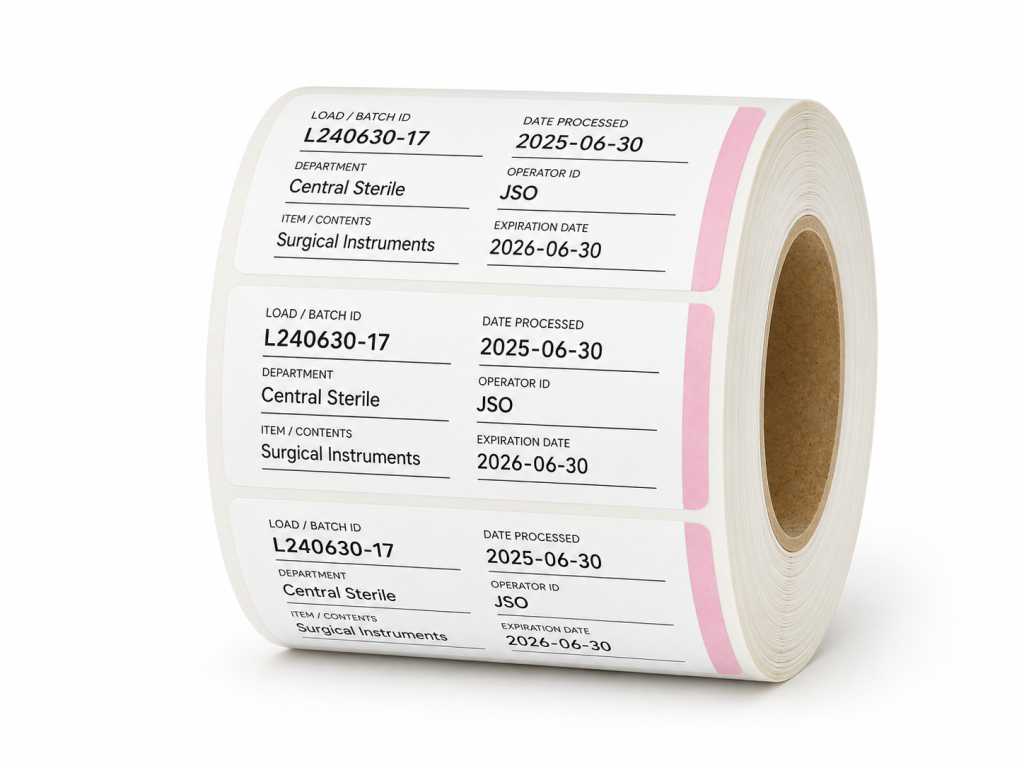
The indicator can be integrated directly into the label while preserving space for barcodes, lot numbers, dates, serial numbers, UDI information, and other variable manufacturing data—without requiring a separately applied piece of indicator tape, dot, or strip.
Find the right labels
- Share your application
- Get expert guidance
- Move forward with confidence
When autoclave process exposure must be immediately visible
Products, containers, and packages may appear unchanged after an autoclave cycle. When process-exposure status is not immediately visible or connected to product identification, distinguishing processed items from unprocessed ones becomes more difficult during inspection, handling, storage, and subsequent use.
- Products, containers, and packages can look identical before and after autoclave processing
- Separate indicator tape, dots, or strips add another application step
- Heat, saturated steam, moisture, pressure changes, and thermal cycling can compromise standard label materials
- Product information and process-exposure status must remain connected through inspection, handling, storage, and subsequent use
What autoclave sterilization indicator labels are engineered to do
Autoclave sterilization indicator labels do more than provide a visible process indication. When engineered as part of the complete labeling system, they can keep process-exposure status connected to product identification while supporting traceability, manufacturing efficiency, and reliable label performance throughout sterilization and subsequent handling.
- Produce a clear, stable visual response following exposure to the steam conditions for which the indicator is designed
- Keep process-exposure status connected to barcodes, lot numbers, dates, UDI information, color coding, and other required product or manufacturing data
- Maintain the required adhesion, legibility, and scanability through autoclaving and post-process handling, with permanent, removable, or record-transfer constructions available based on the application
How integrated autoclave sterilization indicator labels work
An integrated autoclave indicator label keeps product identity and process-exposure status together. Before processing, the indicator is in its defined initial state. Following exposure to the steam conditions for which it is designed, the indicator produces a defined visual response that remains distinguishable throughout the required post-process workflow.
- Applied before autoclave processing
The label is applied in its initial visual state and can include the product identification, regulatory information, barcodes, lot numbers, and variable data required for manufacturing and traceability. - Responds during steam-process exposure
During the autoclave cycle, specialized indicator chemistry produces a defined visual response following exposure to the steam sterilization conditions for which it is designed. - Supports post-process identification
After processing, the changed indicator helps teams distinguish processed items from unprocessed ones throughout inspection, handling, storage, and subsequent use without requiring separate indicator tape, dots, or strips.
Choosing the right autoclave indicator solution
The best autoclave indicator solution balances visible process indication, product identification, application efficiency, adhesion, removability, and reliable performance throughout sterilization and subsequent handling.
These configurations are not mutually exclusive. An integrated indicator label can also be machine applied and engineered with application-specific materials, adhesives, and supply formats.
Standalone autoclave tape, dot, or strip
Best for applications that only require a simple visual indication of autoclave process exposure and can accommodate a separate indicator component and application step.
Integrated autoclave product or container label
Best when process indication must remain connected to product, container, or packaging information such as barcodes, lot numbers, dates, color coding, or variable data. Indicator placement, printable areas, materials, and adhesives should be engineered together to preserve visibility, legibility, and label performance throughout the autoclave cycle.
Machine-applied autoclave indicator label
Best for higher-volume operations using automatic dispensing, print-and-apply equipment, or other automated labeling systems. Label dimensions, spacing, liner release, core size, rewind direction, and dispensing performance should be coordinated with the equipment and production speed.
Application-specific custom construction
Best for applications involving unusual surfaces, repeated autoclave cycles, clean-removal requirements, transfer to batch records, chemical or wash exposure, or long-term identification needs. Indicator chemistry, facestock, adhesive, printing, coatings, and post-process performance should be evaluated as one complete labeling system.
Engineering the complete autoclave sterilization label solution
A visible color change is only one requirement of a successful autoclave indicator label. Reliable performance depends on engineering the indicator technology, facestock, adhesive, printing, label design, container compatibility, and finished supply format as one complete system around the documented autoclave cycle and the product’s full workflow.
| Engineering consideration | Why it matters |
|---|---|
| Indicator response and documentation | The selected indicator should have a defined initial state, exposed endpoint, intended process variables, and supporting technical documentation. The visual response should remain clear and distinguishable for the required workflow without being presented as independent proof of sterility. |
| Autoclave-cycle compatibility | The indicator and every component of the label construction should be evaluated against the documented cycle, including cycle type, temperature, exposure time, saturated steam, pressure, vacuum, drying, cooling, thermal cycling, and number of cycles, as applicable. |
| Surface and adhesive compatibility | The facestock and adhesive should be matched to the container material, surface energy, curvature, application conditions, and required bond. The label must remain securely positioned throughout autoclaving and subsequent handling. |
| Identification and print durability | Product information, barcodes, lot numbers, dates, and variable data should remain attached, legible, and scannable throughout sterilization and post-process use. The label material, print technology, ink or ribbon, and any protective coating should be evaluated as a complete system. |
| Indicator placement and label design | The process indication should remain immediately visible without compromising barcode quiet zones, regulatory content, product identification, color coding, or variable information. The indicator can be integrated as text, a line, a dot, or a custom format based on the available space and inspection workflow. |
| Container and packaging compatibility | Label dimensions, placement, facestock, and adhesive should be evaluated with the complete container or packaging system. The label should not interfere with seals, closures, vents, openings, peel areas, graduations, or required markings. |
| Post-process performance | Depending on the application, the label may need to withstand washing, disinfectants, chemicals, abrasion, refrigeration, storage, or repeated handling after autoclaving. The construction should be engineered for the complete service environment, not only the sterilization cycle. |
| Production and application integration | Label dimensions, die-cut tolerances, roll configuration, rewind direction, liner release, and dispensing performance should align with the application method, labeling equipment, production speed, operator handling, and downstream workflow. |
Where autoclave sterilization indicator labels support manufacturing workflows
Autoclave sterilization indicator labels can be engineered into a wide variety of product, container, and packaging identification systems. While every application presents different cycle conditions, surfaces, printing requirements, and post-process demands, the following examples illustrate common workflows where process indication and identification can be combined into a single engineered solution.
Laboratory media and process containers
Bottles, flasks, vessels, and other containers used for laboratory media or process materials are often labeled before autoclaving. After processing, the label must continue to identify the container while providing a clear visual indication of autoclave exposure.
Integrating the indicator directly into the identification label preserves space for media type, batch or lot number, preparation date, expiration date, color coding, barcodes, and other variable information. The complete construction can also be engineered around glass, polypropylene, and other common container surfaces, as well as any required post-autoclave washing or chemical exposure.
Pharmaceutical and bioprocess manufacturing
Pharmaceutical and bioprocess operations may autoclave containers, components, tools, assemblies, and process materials before they enter controlled production workflows.
An integrated autoclave indicator label helps keep process-exposure status connected to the identifying information used for batch control, line clearance, inventory management, and traceability. Materials, adhesives, and printing can be selected around the autoclave cycle, cleanroom requirements, handling procedures, and the conditions the label will encounter after processing.
Steam-compatible medical devices and reusable components
Medical devices, trays, instruments, and reusable components that are compatible with steam sterilization may be labeled before entering the autoclave.
After processing, the same label may need to identify the device or component, communicate process exposure, support barcode scanning, and remain legible through inspection, storage, transportation, or repeated handling. Depending on the workflow, the label can be engineered to remain permanently attached, remove cleanly, or transfer information to a batch record.
Sterile barrier and secondary packaging
Pouches and trays used as sterile barrier systems, together with cartons and other secondary packaging, may be labeled before steam sterilization.
Once processed, an integrated indicator helps personnel distinguish processed packages from unprocessed ones while the label continues to carry product identification, lot information, dates, barcodes, and other required data. Label placement, facestock, adhesive, and indicator position should be evaluated with the packaging system so they do not interfere with seals, peel areas, required markings, package opening, or sterile barrier integrity.
How we engineer label performance for your application
Label performance depends on how materials interact with your environment, surfaces, application processes, and workflow requirements.
Indicator placement is engineered around your label design to preserve the space needed for product identification, barcodes, variable data, and other operational requirements. Whether the application requires a text change, line, dot, or another custom configuration, the indicator can be integrated into the label layout without compromising functionality.
Text
Provides a clear written process indication that is easy to identify during inspection, handling, and routine workflow activities.

Line
Provides a highly visible process indication while preserving maximum space for barcodes, variable data, and product identification.

Dot
Provides a compact process indication for applications where available label space is limited and printable area is critical.

Chemical exposure
Resistant facestocks and coatings protect printed information from solvents, disinfectants, and harsh cleaning agents.
Cleaning cycles
Abrasion-resistant materials withstand repeated wipe-downs without degrading readability or adhesion.
Temperature conditions
Materials are selected to remain stable across cold storage, ambient, and high-heat environments.
Removal requirements
Adhesives are selected based on whether labels need to remove cleanly or remain permanently bonded over time.
Surface type
Adhesives are matched to plastics, metals, glass, textured materials, and other challenging surfaces.
Application method
Label constructions are designed to support manual, semi-automated, and automated application processes.
Print method
Topcoats are selected to support durable, legible printing across thermal transfer, direct thermal, laser and inkjet systems.
Size considerations
Label dimensions are matched to available surface area, barcode requirements, and readability needs.
Shape requirements
Label shapes are designed around containers, equipment, packaging, and workflow constraints.
Built around your workflow
Label performance is also influenced by how labels are dispensed, handled, packaged, stored, and integrated into day-to-day operations.
Labels per roll
Configured to support production throughput, operator handling, and storage requirements.
Perforations
Designed to improve dispensing, separation, handling, and workflow control.
Special liners
Release liners are selected to support clean handling, reliable release performance, and automated application requirements.
Core size & rewind direction
Roll configurations are matched to your printers and applicators for reliable feeding and operation.
Packaging requirements
Labels can be packaged to support cleanroom handling, sterile workflows, controlled storage, or protection during transport.
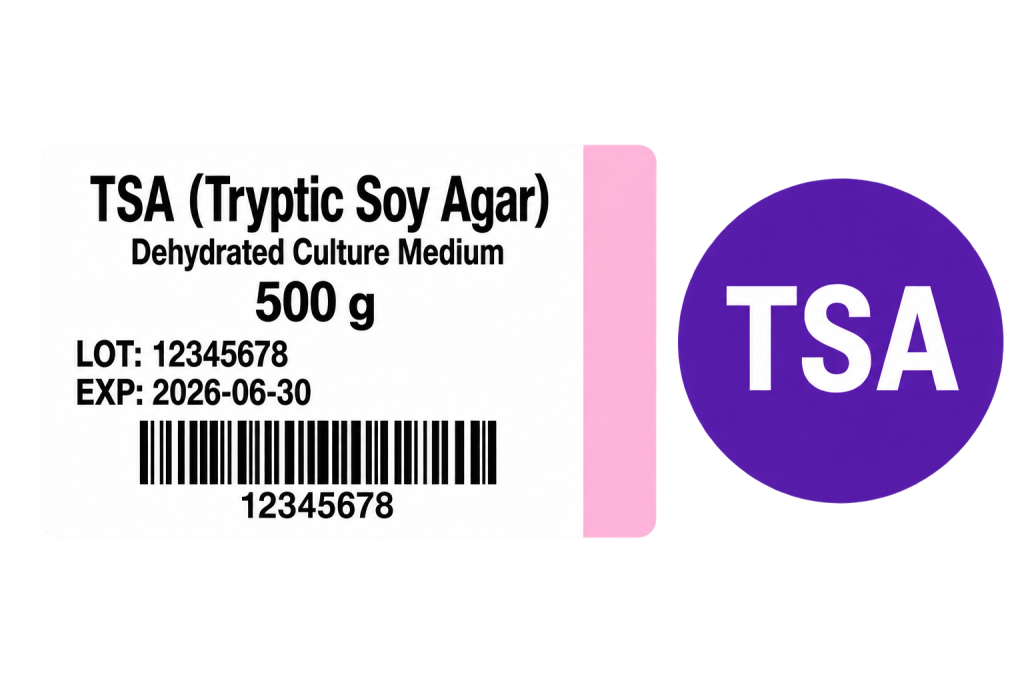
Simplifying autoclave labeling while preserving media identification
A manufacturer of microbial detection products stored 12 different liquid-media formulations in polypropylene bottles that underwent autoclave processing. Each bottle needed to communicate both the media formulation and visible autoclave process-exposure status.
The existing workflow required employees to apply a product-identification label and a separate piece of autoclave indicator tape. This added another labeling component that had to be applied before processing and removed afterward. The manufacturer also needed a reliable way to preserve media identification after the primary autoclave-indicating label was removed.
The Engineered Solution
CleanMark developed a coordinated, multipurpose labeling system that combined autoclave process indication with color-coded media identification.
The primary 2″×1″ label included an autoclave-indicating strip positioned vertically along its right edge. Before processing, the strip appeared light gray. Following exposure to the specified autoclave conditions, it changed permanently to pink, providing a clear visual indication of process exposure without requiring separate autoclave indicator tape.
Each of the 12 liquid-media formulations was assigned a distinct identifying color. A matching 0.5-inch permanent cap label remained attached to the polypropylene bottle after the primary label was removed, allowing the media formulation to remain identifiable throughout the subsequent workflow.
The two label components required different adhesive behaviors. The cap label used an aggressive permanent adhesive designed to remain attached, while the primary autoclave-indicating label used a material-and-adhesive construction engineered to withstand processing and then remove cleanly within three to five days.
The bottles and labels also passed through a laboratory wash cycle involving IPA and Lancer acid. CleanMark selected materials engineered to maintain adhesion, legibility, color identification, and overall integrity throughout both autoclaving and subsequent chemical washing.
Representative constructions were evaluated on the polypropylene bottles under conditions reflecting the customer’s autoclave and laboratory-wash processes before the solution moved into production.
Manufacturing and Business Impact
By combining autoclave process indication and media identification within one coordinated labeling system, the manufacturer:
- Eliminated the separate application and removal of autoclave indicator tape.
- Combined visible process indication and media identification within one compact 2″ × 1″ primary label.
- Standardized indicator placement and color-coded identification across 12 media formulations.
- Preserved media identification after primary-label removal through a matching permanent cap label.
- Maintained the required adhesion, legibility, and identification through autoclaving and subsequent chemical washing.
- Reduced separate labeling components, handling steps, and process variation.
The result was a more controlled labeling workflow that kept autoclave process-exposure status and media identity connected while reducing separate components and handling steps.

Prefer to talk it through?
Share your current label, packaging surface, autoclave processing requirements, printing method, application equipment, and required product information. CleanMark’s technical team will evaluate the complete labeling application and identify the construction and qualification considerations.

