















Sterile labels engineered around your application.
Sterile labels are sterilized and packaged for use in aseptic, sterile and contamination-controlled workflows. We evaluate the label construction, packaging, printing, application and sterilization together—so identification remains reliable throughout your process.
Not sure of the exact construction or configuration? You don’t need to be.

We start where you are.
Whether you’re solving a performance problem, qualifying a new application, adapting to changing requirements or looking for a more reliable supplier, we start by understanding what your process requires.
Something isn’t working
Poor adhesion, print failure, packaging or transfer issues, sterilization-related performance problems or other performance challenges.
New application or qualification
Define requirements and reduce unnecessary trial-and-error before scale-up.
Requirements have changed
A new surface, environment, process, quality requirement or operating condition.
Supplier performance isn’t meeting expectations
Inconsistent performance, long lead times, poor responsiveness or limited technical support.
A sterile label has to do more than arrive sterile.
The label has to maintain reliable identification while fitting into the packaging, transfer, printing, application and sterile-use processes around it.
Arrive in the required sterile state
Sterilization and packaging are considered around your process and handling requirements.
Stay securely in place
Maintain adhesion through the conditions the label encounters during use.
Remain readable
Keep printed information, barcodes and variable data legible throughout the required service life.
Support sterile transfer and use
Packaging and configuration should fit the way labels enter and are used within the sterile workflow.
Sterilizing the label is only part of the solution.
A sterile label becomes part of a larger aseptic workflow. Construction, packaging, transfer, printing, application and sterilization requirements all need to be considered together.
Sterile labels are sterilized and packaged for introduction into sterile or aseptic workflows. CleanMark’s sterile-label offering uses gamma sterilization, with the construction and format selected around the intended use.
| Factor | Sterile label solution | General-purpose label |
|---|---|---|
| Sterilization | Sterilization requirements are incorporated into the solution. | Not normally supplied sterile. |
| Packaging | Packaging is evaluated around controlled transfer and handling. | Standard commercial packaging. |
| Construction | Materials are evaluated for the use conditions and sterilization requirements. | Selected primarily for general use. |
| Identification | Printing, barcodes and variable data are considered as part of the complete labeling system. | General printing requirements. |
| Workflow | Printing, dispensing, application, packaging, sterilization and transfer are coordinated around the required process. | Typically focused primarily on label application. |
The right label starts with the application.
We evaluate the variables that matter, understand how they interact and configure the label around those requirements.
The construction is engineered around sterile-use requirements.
Sterilization, environment, surface, identification and workflow requirements help determine the materials, adhesive and overall construction.
| Application variable | What we evaluate | What it can influence |
|---|---|---|
| Sterilization | Gamma exposure, process requirements and material compatibility | Facestock, adhesive and print system |
| Environment | Sterile or aseptic conditions, cleaning, temperature, moisture and handling | Construction and print durability |
| Surface | Material, geometry, surface characteristics and removability | Adhesive and label geometry |
| Identification | Printing technology, barcode requirements, variable data and readability | Facestock, print treatment and print compatibility |
| Workflow | Printing, dispensing, application, packaging and handling | Liner, roll configuration and packaging |
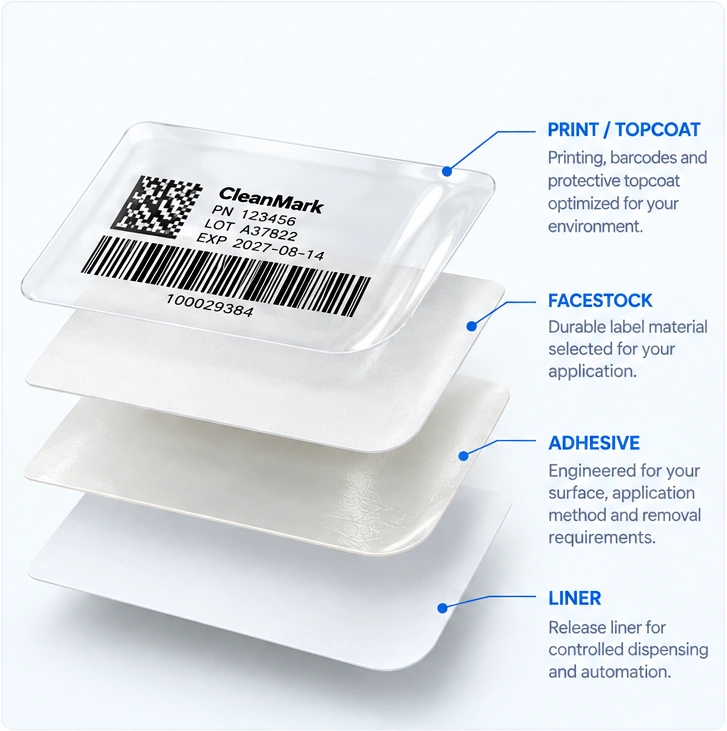
Sterile doesn’t define the construction. Your application does.
Construction, format and configuration are selected around the environment, surface, printing equipment and workflow.
Paper-based sterile labels
When a paper construction provides the required performance and workflow compatibility.
Cleanroom-compatible sterile labels
When contamination-control considerations also influence material and construction selection.
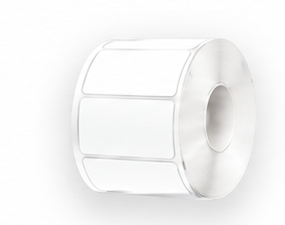
Roll labels
Die-cut labels supplied on rolls for printing, dispensing or application workflows.
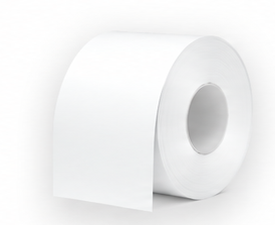
Continuous rolls
Continuous material configured around printing and use requirements.
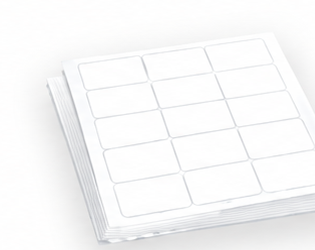
Sheets
Sheeted labels for manual application or workflows that do not require roll-fed dispensing.
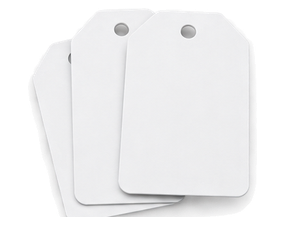
Tags
Durable tags for identification and traceability where an adhesive label is not the preferred format.
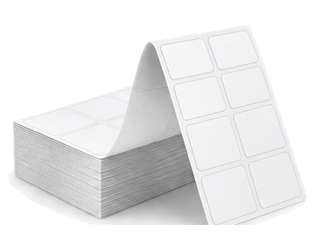
Fanfolded
Fanfolded labels for printers and application systems configured to use fanfolded media.
Size and shape are engineered around the surface and process.
Available labeling area, surface geometry, information requirements and application method all influence final label size, shape and layout. Custom dimensions, shapes, corner radii and die-cut geometries can be engineered around the application.
Available labeling area
Usable space, size constraints and clearance.
Surface geometry
Flat, curved, cylindrical or irregular surfaces.
Information requirements
Barcodes, variable data, text and symbols.
Application method
Manual, semi-automated or automated.
Built around what you’re labeling.
From vials and tubes to carriers, packaging and process containers, label size and geometry are configured around the application.

The process determines how the label needs to work.
Printing, dispensing, application, packaging, sterilization and sterile transfer do not always occur in the same order. We evaluate how these requirements fit together in your actual workflow.
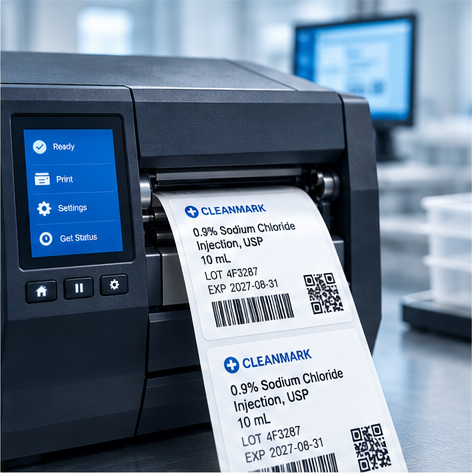
Printing
Identification has to remain clear and repeatable.
- Printing technology
- Ribbon or ink
- Barcode + variable data
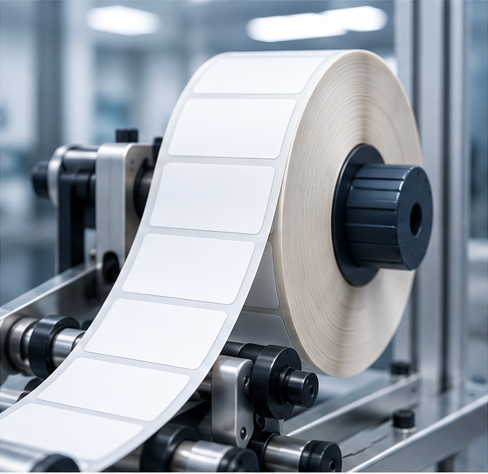
Dispensing
The roll has to move reliably through the equipment.
- Core
- Rewind
- Liner + spacing
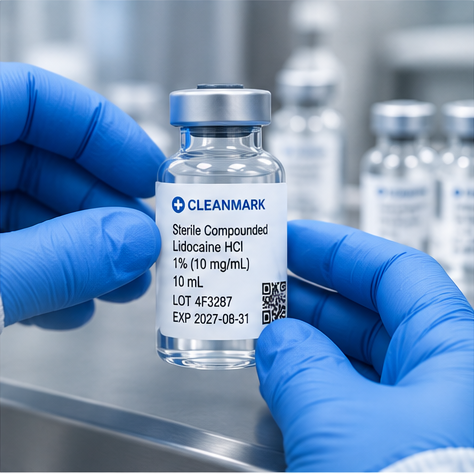
Application
The label must apply correctly to the intended surface.
- Manual
- Semi-automated
- Automated
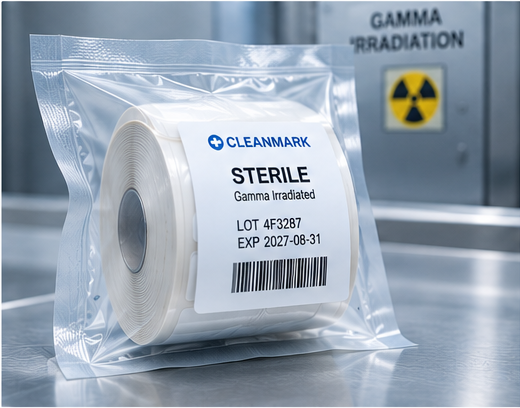
Packaging + sterilization
Packaging and gamma processing have to work with the label construction.
- Packaging requirements
- Gamma sterilization
- Process compatibility
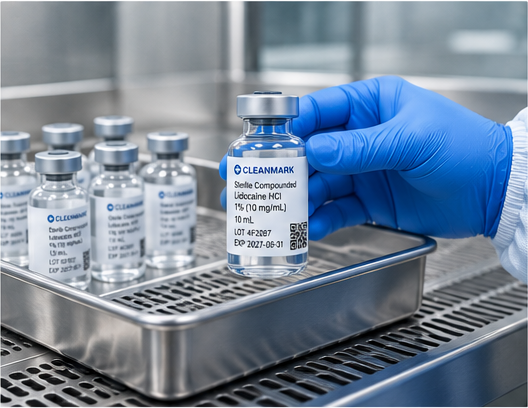
Sterile transfer + use
The supplied format needs to fit the customer’s controlled-use process.
- Transfer method
- Handling
- Point of use

Closing the final nonsterile gap—without changing the labeling workflow.
A sterile compounding organization used continuous-roll labels with automated printers and applicators for IV bags and syringes. The label rolls remained one of the final nonsterile components entering the operation.
The labels needed to be supplied in a sterilized format without requiring a redesign of the existing printing and application process.
Construction, printing, roll configuration, automated application, packaging, sterilization and handling were evaluated together.
The right solution matters. So does the company behind it.
When you work with CleanMark, you can reach people who understand your requirements, get answers from the team closest to the work, and know that decisions made during evaluation stay connected through production. Our technical, customer-support and manufacturing teams work together around your needs.
Direct access
Work directly with CleanMark team members who understand the technical and operational requirements behind your project.
Faster answers
Questions move quickly to the CleanMark team member best positioned to resolve them and keep your project moving.
Fewer handoffs
Your requirements and technical decisions stay connected as the solution moves from evaluation into production.
Follow-through
What we agree to during evaluation carries through to production, delivery and ongoing support.
Tell us what you know. We’ll help determine the rest.
You don’t need to have the label figured out before contacting us. Share what you know, and we’ll help identify the next step.
Requirements review
Clarify the requirements and open questions.
Candidate solution
Identify a likely construction and configuration.
Evaluation
Determine the testing or qualification path.
Production-ready solution
Finalize the confirmed specification.
Common questions.
Quick answers about sterile labels, gamma sterilization, construction, configuration and workflow.
What are sterile labels?
Sterile labels are labels that have been sterilized and packaged for introduction into a sterile or aseptic workflow. The label construction and supplied configuration still need to be appropriate for the intended use.
How are CleanMark sterile labels sterilized?
CleanMark’s sterile-label offering uses gamma sterilization. Construction, packaging and sterilization requirements are reviewed together in the context of the customer’s process.
Can sterile labels be paper-based?
Yes. Sterility does not by itself determine the facestock. Depending on the use case, a paper-based or cleanroom-compatible construction may be appropriate.
Can sterile labels also be cleanroom compatible?
Yes. Sterility and cleanroom compatibility describe different requirements. A label can be sterile, cleanroom compatible, or both depending on the process requirements.
What is the difference between a cleanroom label and a sterile label?
Cleanroom labels are designed around contamination-control requirements for controlled environments. Sterile labels are supplied in a sterilized state for introduction into sterile or aseptic workflows. Depending on the use case, a label may need to meet one requirement or both.
What is the difference between sterile labels and sterilization indicator labels?
Sterile labels are supplied in a sterilized state for use in sterile or aseptic workflows. Sterilization indicator labels are designed to provide visual evidence of exposure to a sterilization process. They serve different purposes.
Can sterile labels be supplied as roll labels, continuous rolls or sheets?
Yes. Sterile labeling solutions can be supplied as die-cut roll labels, continuous material or sheets depending on printing, dispensing, application and handling requirements.
Can sterile labels support barcodes and variable data?
Printing technology, ribbon or ink, construction, barcode requirements and expected use conditions can be evaluated together to support readable identification.
Will sterile labels work with our existing printer or applicator?
Existing equipment can be evaluated as part of the requirements review. Core, rewind, liner, spacing, printing technology and application method can all influence compatibility.
What can be customized?
Depending on the use case, construction, dimensions, shape, roll configuration, printing compatibility and packaging can be evaluated and configured around the process.
What sterilization documentation is available?
Documentation requirements should be established during requirements review. Available records and supporting information can vary based on the solution and sterilization program.

