Cold can change the construction.
The adhesive and material need to remain secure and usable throughout extended dry-ice exposure.








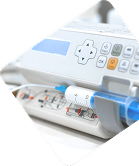







Custom identification labels for materials shipped or handled in dry ice. Match the construction to your container, application conditions, dry-ice exposure, shipment duration, temperature transitions, abrasion, and printing requirements.
For vials, tubes, syringes, applicators, bottles, sample containers, and shipping materials.

A label may be applied at room temperature, packed into dry ice, exposed to ultra-cold conditions for hours or days, handled during transit, and then returned to much warmer temperatures at the destination. The construction has to work through that entire sequence.
The adhesive and material need to remain secure and usable throughout extended dry-ice exposure.
The label also needs to maintain integrity before packing and after the shipment reaches its destination.
Condensation can develop rapidly as cold containers return to warmer conditions.
Labels may be rubbed, stacked, handled, and moved throughout packing, transit, and receipt.
Text and barcodes need to remain usable when the shipment reaches its destination.
Select every challenge in your workflow. Your selections help define the complete application.
Support identification of temperature-sensitive materials moving between facilities, laboratories, manufacturers, clinical sites, and distribution points. Specify the complete shipping sequence so the label can be evaluated for ultra-cold exposure and the return to warmer conditions.
Maintain identification through packing, dry-ice transit, receipt, and transfer into controlled storage.
Keep sample identification attached and readable through ultra-cold transport and destination handling.
Protect critical product identification when materials must travel in dry ice before returning to room or controlled temperatures.
Match the adhesive to the substrate, geometry, application temperature, and conditions present before the shipment is packed.
Include whether the label is applied at ambient, refrigerated, or already-cold conditions.
Evaluate the adhesive, facestock, printing, and protection through dry-ice exposure, handling, abrasion, frost, and condensation.
Include the actual printer and ribbon when printing onsite.
Consider packing conditions, shipment duration, destination temperatures, cleanroom requirements, and downstream handling together.
A temperature-sensitive applicator may be labeled at room temperature, packed in dry ice for shipment, exposed to ultra-cold conditions for an extended period, and then returned to much warmer temperatures at the destination.
Throughout that sequence, the label needs to stay attached and readable—without losing integrity during the cold exposure or as the product warms.
CleanMark helps match the adhesive, material, and printing to the container and shipping process, so identification stays with the product from packing through delivery.
Share what you know. Only your first name, last name, and email are required.
Step 1 of 3 — Application
Anything left open can be discussed with our team.
Schedule a conversation about your dry-ice application →
Prefer to talk it through? Schedule a conversation →
Include the actual temperature range and shipment sequence rather than relying on a single nominal value. Also include the conditions before packing, during transit, and after the shipment reaches its destination.
Share the expected shipment duration and whether the package may be replenished with dry ice during transit. Exposure time is one part of evaluating the complete label construction.
The complete transition should be evaluated. Include the application temperature, time in dry ice, destination conditions, condensation during warming, and any handling after receipt.
Share the container material, diameter or geometry, label dimensions, and overlap. Tight curvature can affect edge adhesion and the available area for readable identification.
Evaluate the barcode after the complete sequence, including dry-ice exposure, transit, abrasion, frost, condensation, and warming at the destination. Include your actual print setup when printing onsite.
Include your printer, ribbon or other print technology, and when printing occurs in the workflow. The printing system and label construction should be evaluated together.
These requirements can be considered together. Specify packaging, cleanroom handling, sterilization exposure, chemicals, and downstream use so the recommendation reflects the complete workflow.

