Applied before or after freezing.
The adhesive must establish a bond under the conditions present when you apply the label.








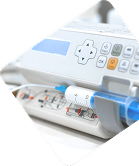







Custom identification labels for frozen samples, reagents, biologics, and pharmaceutical materials. Match the construction to your containers, storage temperatures, frost, condensation, and handling requirements.
For sample tubes, vials, reagent containers, freezer boxes, and process materials.

The label may be applied before freezing or to an already-cold container, exposed to frost and condensation during retrieval, and moved repeatedly between frozen storage and use. Those transitions can matter as much as the storage temperature itself.
The adhesive must establish a bond under the conditions present when you apply the label.
Moisture during storage and retrieval can challenge both adhesion and printed identification.
Repeated temperature transitions and freeze-thaw cycles make the complete service history important.
Tubes and vials create tight radii where label fit and edge adhesion become especially important.
After frozen storage, retrieval, and handling, the barcode must remain usable at the point of use.
Select every challenge in your workflow. Your selections help define the complete application.
Support identification across pharmaceutical and biotech manufacturing, cell therapy and biologics, and laboratory & QC applications. Specify your actual temperature range; label performance depends on the recommended construction and application.
Maintain identification through controlled frozen storage, handling, cleaning, transfers, and downstream processing.
Identify frozen materials between processing steps, including workflows that involve retrieval, thawing, and return to controlled storage.
Keep samples and materials identifiable through freezer storage, inventory retrieval, handling, analysis, and return.
Match the adhesive to glass or plastic, container curvature, and the temperature and moisture present during application.
Include whether you label before freezing or after the container is already cold.
Evaluate the facestock, printing, and protection through frozen storage, frost, condensation, handling, and any chemical wipe-downs.
Include the actual printer and ribbon when printing onsite.
Consider cleanroom packaging, dispensing, and any sterilization exposure alongside freezer performance.
A QC stability sample may spend weeks or months in frozen storage, then be retrieved for testing, handled at the bench, exposed to frost or condensation, and returned to the freezer for future analysis.
Throughout that cycle, the label needs to stay attached, remain readable, and keep its barcode scannable.
CleanMark helps match the adhesive, material, and printing to your vial, storage conditions, and handling process—so the sample remains identifiable from frozen storage through testing and return.
Share what you know. Only your first name, last name, and email are required.
Step 1 of 3 — Application
Anything left open can be discussed with our team.
Schedule a conversation about your freezer application →
Prefer to talk it through? Schedule a conversation →
Include the actual storage temperature, the temperature and condition of the container when labeling, its material and shape, and what happens during retrieval, handling, cleaning, and return to storage. Storage temperature alone does not define the complete application.
Tell us the container temperature and whether the surface is dry, damp, or frosted. Adhesion during application must be evaluated separately from performance after the label is already attached.
Include the frequency of temperature transitions, how warm the container becomes during use, and whether moisture develops during each cycle. The complete sequence should be considered when evaluating the construction.
Share the container material and diameter, label dimensions, and barcode requirements. Tight curvature and limited surface area affect label fit, edge adhesion, and where identification can be read or scanned.
Include your printer, ribbon or other print technology, and the point in the workflow when printing occurs. The recommended construction and printing system should be evaluated together for the complete freezer workflow.
These requirements can be considered together. Specify the packaging and handling needs, plus any sterilization process, so material selection and evaluation reflect the full workflow.
Include those exposures when requesting a recommendation. The label should be evaluated across the complete temperature sequence, including ultra-low, dry ice, or cryogenic exposure—not freezer storage alone.

